
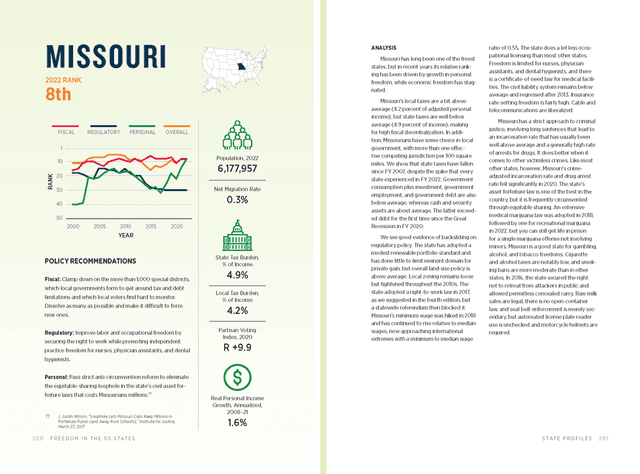
Policy Recommendations
- Fiscal Clamp down on the more than 1,000 special districts, which local governments form to get around tax and debt limitations and which local voters find hard to monitor. Dissolve as many as possible and make it difficult to form new ones.
- Regulatory Improve labor and occupational freedom by securing the right to work while promoting independent practice freedom for nurses, physician assistants, and dental hygienists.
- Personal Pass strict anti-circumvention reform to eliminate the equitable-sharing loophole in the state’s civil asset forfeiture laws that costs Missourians millions.
Analysis
Missouri has long been one of the freest states, but in recent years its relative ranking has been driven by growth in personal freedom, while economic freedom has stagnated.
Missouri’s local taxes are a bit above average (4.2 percent of adjusted personal income), but state taxes are well below average (4.9 percent of income), making for high fiscal decentralization. In addition, Missourians have some choice in local government, with more than one effective competing jurisdiction per 100 square miles. We show that state taxes have fallen since FY 2007, despite the spike that every state experienced in FY 2022. Government consumption plus investment, government employment, and government debt are also below average, whereas cash and security assets are about average. The latter exceeded debt for the first time since the Great Recession in FY 2020.
We see good evidence of backsliding on regulatory policy. The state has adopted a modest renewable portfolio standard and has done little to limit eminent domain for private gain, but overall land-use policy is above average. Local zoning remains loose but tightened throughout the 2010s. The state adopted a right-to-work law in 2017, as we suggested in the fourth edition, but a statewide referendum then blocked it. Missouri’s minimum wage was hiked in 2018 and has continued to rise relative to median wages, now approaching international extremes with a minimum to median wage ratio of 0.55. The state does a lot less occupational licensing than most other states. Freedom is limited for nurses, physician assistants, and dental hygienists, and there is a certificate-of-need law for medical facilities. The civil liability system remains below average and regressed after 2013. Insurance rate-setting freedom is fairly high. Cable and telecommunications are liberalized.
Missouri has a strict approach to criminal justice, involving long sentences that lead to an incarceration rate that has usually been well above average and a generally high rate of arrests for drugs. It does better when it comes to other victimless crimes. Like most other states, however, Missouri’s crime-adjusted incarceration rate and drug arrest rate fell significantly in 2020. The state’s asset forfeiture law is one of the best in the country, but it is frequently circumvented through equitable sharing. An extensive medical marijuana law was adopted in 2018, followed by one for recreational marijuana in 2022, but you can still get life in prison for a single marijuana offense not involving minors. Missouri is a good state for gambling, alcohol, and tobacco freedoms. Cigarette and alcohol taxes are notably low, and smoking bans are more moderate than in other states. In 2016, the state secured the right not to retreat from attackers in public and allowed permitless concealed carry. Raw milk sales are legal, there is no open-container law, and seat belt enforcement is merely secondary, but automated license plate reader use is unchecked and motorcycle helmets are required.